Showing posts with label Articles. Show all posts

Tuesday, 22 February 2011

Use your backside.

Pertaining to the three principles laid out in the previous post, today's training was simple, aimed toward my own goals, done in just around 20 minutes, and all could be done without moving much outside of 1 square metre.

4 sets of overhead kettlebell press to failure
4 sets of pseudo planche pushups to failure
followed by the conditioning session in the video below.


The two objects in the video, a kettlebell and sandbag, are both to be found in the gym in a variety of different weights suitable for any ability. One aspect they both share in common is the 'unconventional' weight distribution. Unlike an equally balanced dumbbell, barbell, or resistance machine, the mass of the kettlebell is outside of the handle, while the weight distribution of the sandbag is constantly shifting with every movement. The sandbag in particular makes training more taxing on the entire musculature as the whole body is fighting to counter against the shifting centre of gravity of the bag. The awkwardness means that front squatting it also creates considerable torque around the torso and hip, creating even greater demands on keeping the centre of gravity where it needs to be.
Both exercises place emphasis on different fundamental movement patterns; in the video the sandbag is used for squatting, whilst the kettlebell is used for bending, both exercises constituting fundamental aspects of human movement. Firstly, the squat is a skill that is increasingly being lost in our sedentary society. In other less-developed countries, from baby to elderly, sitting in a full squat whilst eating, playing cards, going to the toilet etc is a daily habit which is just taken as standard.
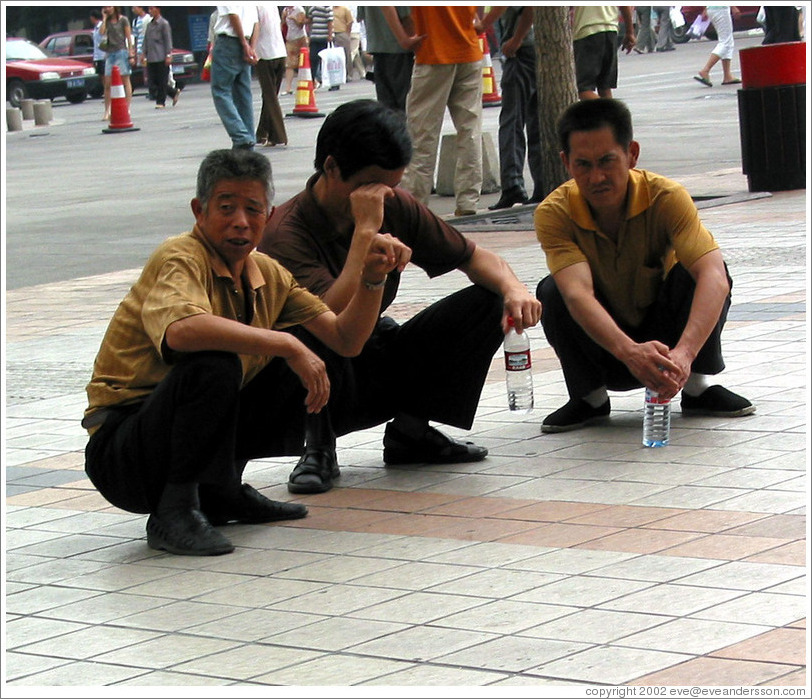


Long periods of sitting forming part our society's daily living has had a massive impact on many of us. As Craig Weller states:

"The hips and ankles are immobilized and because the force is being relegated mainly to the quads, the effect of the posterior chain is minimized. The musculature of the lower back will be overactive in order to support the weight of the upper body without much assistance from the glutes. The thoracic spine will generally be flexed forward into a kyphotic posture."

Basically, this means that sitting disrupts and alters the natural mechanics of our bodies, and over extended periods of time, that effect can become further exaggerated.
In a sitting position (on a chair), our hips are closed to 90 degrees, becoming ever-tighter, whereas the muscles we are sitting on, our glutes, are constantly being massaged by sitting, and are in a stretched, weakened state. The posterior chain (basically the glutes, lower back, and hamstring muscles) tends to be the least developed area of the body of the society that we live in. A strong posterior chain will help decrease the risk of lower back pain, promote good posture, as well as stabilise the whole body in all movement (OLF, EKI course manual), from sprinting to picking up your baby.
In order to strengthen this area of the body, bending movements as well as stabilizing exercises are generally adopted. Stand up and tighten your glutes as hard as you can, then try and bend forward at the hip. Opening the hip, to go from bent over to standing up straight, is the job of the posterior chain. Kettlebell swings and snatches are therefore great exercises in this regard, learning how to stabilise the torse and spine whilst bending from the hip, knee, and ankle under load. Getting the kettlebell overhead has zero to do with upper body strength and everything to do with generating maximum power from the posterior chain to spring the hips forward and torso upright, sending the kettlebell upward like a ball on a chain.

Loading up the posterior chain ready to fling that kettlebell...

.....BAM, full extension from full posterior contraction.

As for the gym, still looking at a 1st/2nd of March date for signing, then its moving in and getting everything done to welcome you all in!

Keep PUSHing,

Thursday, 17 February 2011

3 Quick Points

The vastness and variation within the "health and fitness industry" means that many people are doing many things in many different ways, good and bad and all in between. The act of training is not particularly difficult. Sport-specific exercises that require technique may be challenging such as Olympic lifting, or the feeling that accompanies annihilating oneself in the gym may be unpleasant at the time, but overall its a fairly simple process. The difficult part is training intelligently, planning what you are doing, keeping a track of the progress, adjusting things in response to performance, finding the time to do it, getting the nutrition right, etc. Therefore, each session should be as useful and effective as possible, based on optimum levels of all the other things that affect each session as just mentioned. Below are just three basic fundamentals to ensure effective training.

1) Have some direction.
Have a clear idea of what you want to get out of the hours you are putting in rather than just randomly performing different things each time you train. Having no direction or goals dilutes any substantial gains that you may otherwise get from the efforts. You get better at what you choose to do, so think about what it is you want and then do a little research on what you need to do to achieve it. For example, Circuit training is great for "general fitness". Bodybuilding-type split training is great for putting on more muscle mass. Slow, steady cardio is good for your heart and lungs but may negatively affect your power and maximal strength. Lifting maximal weights for lower repetitions will improve your maximal strength but have little to no effect on improving cardiovascular fitness. Have an idea of what you want and then train in that way.

2) Keep it simple.
Don't over complicate things, sticking to the basics are always a safe bet. The hard, brutal, simple things are also usually the best. Many gyms have made it easy to get confabulated with the plethora of resistance and cardio machines available. One barbell and some weight plates will get you very strong. Pullups and dips will give you immense upper-body development. Sprinting in parks and running up hills will give you iron lungs and a strong heart. These things are simple but hard, and the laws of progression means it never gets easier.

3) Time is not an excuse.
An effective session can be done in even under 10 minutes. Time is never an excuse not to train. Everyone has the same 24 hours but different people have different priorities and tolerances for making the time for certain things, exercise often down on the list if things become busy. For example, a Tabata is a very effective method for improving anaerobic and aerobic fitness. This will sort you out in under 5 minutes:
Burpees
20 seconds as many as possible then 10 seconds rest, repeat for 8 rounds total.

Keep it focused, simple, and consistent!

Sunday, 2 January 2011

Move!

Happy New Year! The start of a new year and a fresh canvas to make our mark upon!

Now, how awfully predictable that shortly after the Christmas and New Year period a blog about training and fitness will throw up a piece about "smelting down that Xmas pud of a belly!", or something to that effect. However, keeping in line with such tradition, I am going to do just that very thing, albeit brief.

Losing weight, technically, is a straightforward procedure, somewhat obscured by circumstances, subjective experience, the media, etc. That is another issue, the good thing is that if we take away all the things clouding fat loss and just concentrate on the body simply as is, the equation to weight loss becomes clearer, and good job too.

Its essentially the law of thermodynamics. One must expend more energy (calories) than one intakes. If someone is training but still not losing weight, somewhere along the line they are still taking in too much too lose the excess weight. The above equation is true for the overwhelming majority of the population.

Fat and glucose are two of the major energy sources for any activity, even just sitting down doing nothing. As for anyone laying any claim to some sort of "fat burning zone", some mysterious intensity of exercise where fat is most efficiently burned, such notions can be flatly ignored. In fact, the body utilizes fat as an energy source the MOST when it is at rest. So why don't we just do nothing and burn off all the fat? Because unfortunately, doing nothing expends very little energy (calories), and so the above law says that we will not lose weight. However, what IS important, is how many calories you burn, not how much fat as an energy source! And to do this, we simply need to move!

Post-exercise, our metabolism is raised, and as a result, more energy is being 'burned' for hours after training. So after exercise we are burning much more than before we started, and as a result, that fat is being scorched away too.

After spending a year-long dissertation researching all the potential factors as to why the Chinese population is becoming more overweight in recent decades, it all came down to one simple reason. Calories in are increasingly greater than calories expended. There are a plethora of contributing factors to this, but at the heart of it this is all it is, and its all the body knows and responds to.

So at the end of the day, just remember to expend more than you are putting in, and that means moving and eating healthy.

Also, this stuff doesn't have to be boring! Push Training is all about taking exercise back to how it felt when being a kid, like play! Of course, we play hard...

A prime example here is of one high school teacher, Sam, showing how its done. Starting three years ago at 125kg, Sam has now lost 40kg through finding joy in the movement he does. Just compare the top video, of him before, to the one below.


Here is his blog: Sam Books and Thoughts